
Hampstead Hill Academy is committed to providing all students with an academically rigorous and engaging education that meets each child’s individual needs and pushes him/her to excel.
Direct Instruction (DI)
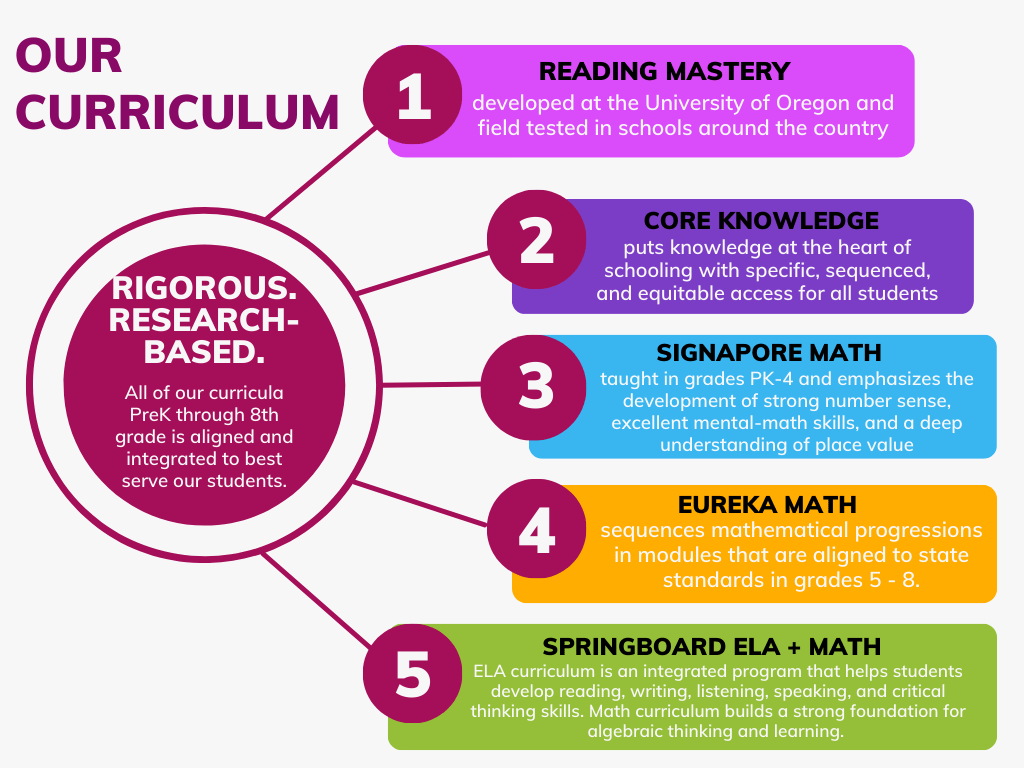
In grades PreK – 5, the Direct Instruction program is utilized as the primary reading and language curriculum. Direct Instruction is a research-based, data-driven model that emphasizes teaching concepts to mastery. Students are placed in instructional groups based on their individual needs. All skills and concepts are explicitly taught in a highly-structured learning environment and practiced until students are capable of performing the tasks independently. This program has proven to be successful with all learners, including students with special needs and high performing students. We are proud to share that over 95% of our students are placed in groups on or significantly above grade-level.
Math
In PreK and kindergarten, Singapore Dimensions is the primary program used for math. In grades 1 – 4, Singapore Math Common Core Edition is the primary math program. Singapore Math is based on the highly successful instructional practices in Singapore. This program balances both creative thinking and problem solving with basic fundamental drills. At its core, the program seeks to provide a solid foundation in number sense, and area which research has proven to be most important in understanding how to build complex mathematical concepts. In 5th grade, Eureka Math is used, which directly aligns to the Grade 5 Math Common Core State Standards. This program also balances both creative thinking and problem solving with basic fundamental drills. With a focus on word problems, Eureka will help to prepare students for the rigor of middle school math.
Middle School Grades – All Students in Middle School Experience a Rigorous Curriculum
The goal of HHA’s middle school curriculum is to best prepare our students for high school and beyond. In English Language Arts, writing is an essential skill and practiced frequently using the Springboard Curriculum. Students are exposed to a variety of writing styles including personal narratives, argumentative essays, literary responses and expository writing. For Social Studies, History Alive! is the curriculum for Ancient Civilizations (Grade 6) and US History (Grades 7 and 8). In addition, all middle school students engage in a rigorous, project – based learning unit around National History Day.
In math, Eureka is used in all grades. Again, our goal is to prepare students for success in high school. In science, students cover a range of life, earth and physical science concepts using the IQWST Curriculum.
Science/Social Studies/Food for Life
In every grade-level, students have opportunities to learn about the world around them in science class. PreK – 2 use Core Knowledge, and grades 3 – 5 use FOSS Next Generation Science. Students learn through hands-on experiments and projects. In grades 6-8, students cover a range of life, earth and physical science concepts using the IQWST Curriculum.
Students also engage in social studies. Grades PreK – 2 use Core Knowledge and grades 3 – 5 use Social Studies Alive!. Middle school grades 6-8 use History Alive!.
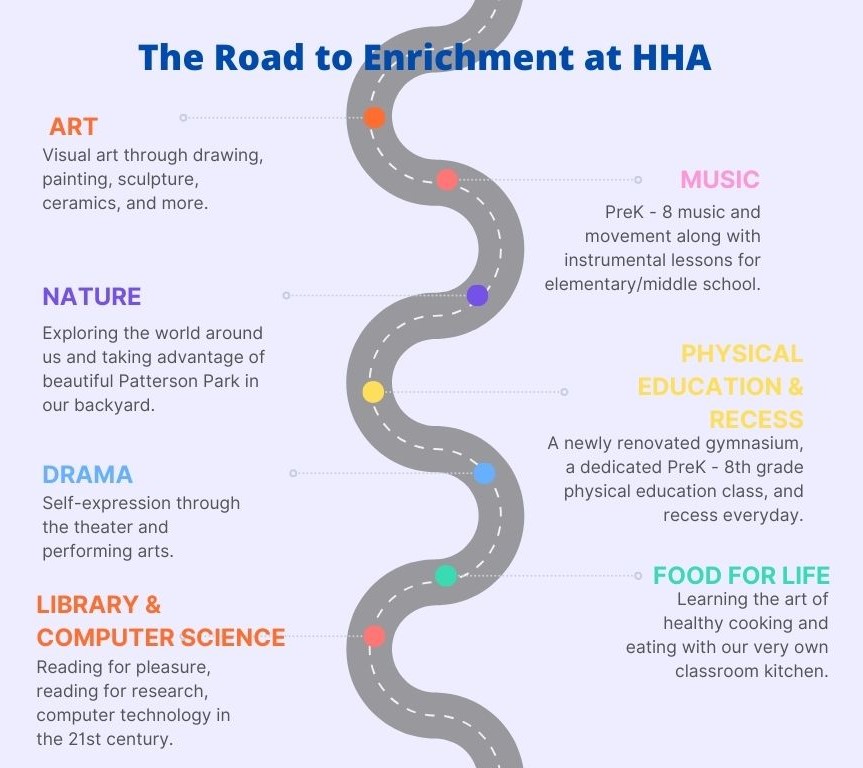
In Food for Life, students learn about healthy eating and have an opportunity to taste new fruits, vegetables and dishes. Learning about the HHA garden is also part of the Food for Life curriculum. The garden allows the students hands-on opportunities to learn both about plant biology and nutrition. Food for Life began at HHA in 2004 and is based on the award-winning Food is Elementary curriculum developed by the Food Studies Institute. To learn more, please visit www.foodstudies.org
Enrichment Classes
Enrichment classes at HHA enhance the core curricular studies in the classroom through physical education, orchestra, band, art, library, computer science/language exploration, nutrition class, drama, music and health. Instrumental music is provided through elective small group instruction with a part-time staff member. HHA knows that a robust, holistic education must include an exploration of art, culture, language, literature, a comprehensive view of health and wellness and social and emotional learning. Enrichment classes are taught in seven-day phases and every student has an enrichment period each day.
 Hampstead Hill Academy